Introducing the Six Layers of Ohio Veterans Memorial Park
From time to time, people ask a seemingly simple question:
“Who does Ohio Veterans Memorial Park belong to?”
That question is deceptively simple in form but surprisingly complex in substance because it collapses multiple distinct legal relationships into a single verb: belong.
In law, a question about belonging fractures into multiple questions pertaining to distinct doctrines, such as: Who owns the land? Who governs? Who is entrusted to act? Who owes obligations? Who enables? And who is protected? As such, it becomes a question that can quietly generate misunderstanding when different people answer it from different points of view. When those questions are separated and answered in their proper legal context, most disagreements about the memorial resolve themselves.
This post is intended to align the public story of Ohio Veterans Memorial Park (OVMP) with its legal reality, in a way that provides factual clarity without posturing, persuading, arguing, or justifying. To do that, we need a structure that explains why authority exists where it does, why stewardship looks the way it does, and why certain roles carry obligation rather than discretion. That structure falls cogently into six layers. But first, the background.
A Place Born of Persistence and Purpose
The creation of the OVMP was the result of years of persistence, repeated setbacks, and sustained commitment by veterans and supporters who believed that Ohio’s fallen deserved a permanent, dignified place of remembrance within their home state. As documented in the book, 3095 Plus: Ohio’s Fallen (link), throughout the early chapters of the OVMP’s history, the original vision centered on creating an Ohio-based memorial inspired by the profound impact of the Vietnam Veterans Memorial in Washington, D.C. and the traveling Vietnam Wall. But, turning that inspiration into a physical place proved far more difficult than anyone initially anticipated.
Before the memorial found its home, multiple potential locations were explored across different Ohio communities and settings. Each presented promise, and each ultimately fell through for different reasons, some logistical, some political, some financial. What matters most in hindsight is the sheer breadth of the search and the amount of effort invested over multiple years to find a location that could truly support the mission.
The eventual placement of Ohio Veterans Memorial Park within Clinton Cemetery stands out as both fitting and providential. Clinton Cemetery’s extension, now known as Clinton Cemetery East, was not merely available land. It was, and remains, legally-dedicated cemetery property, already governed by principles of permanence, respect, and long-term care, an alignment between cemetery purpose and memorial mission that allowed what had proven elusive elsewhere to become realizable at Clinton Cemetery.
The 2007 Agreement: A Framework for Permanence and Responsibility
With the selection of Clinton Cemetery East as the site, the project entered a new and more formal phase, marked by the execution of the 2007 Agreement to Erect a Permanent Memorial, a document that continues to shape how the OVMP memorial grounds exist today. Anyone seeking to understand the OVMP, whether as a visitor, donor, volunteer, or board member, should be familiar with this agreement and the legal framework it sits within.
The 2007 Agreement grants the OVMP organization permission to construct and maintain a permanent memorial on a defined 1.7-acre parcel within Clinton Cemetery East, on the condition that the OVMP organization bears responsibility for the maintenance, utilities, insurance, repairs, and security of the memorial as obligations of cost, care, and liability rather than governance or control. The Agreement conditions the OVMP organization’s ability to make or construct improvements on adherence to the plans, renderings, and terms set forth in the Agreement, and requires compliance at all times with applicable local, state, and federal laws, regulations, and codes, which includes Ohio cemetery law that governs cemetery property.
The Agreement expressly preserves Clinton Cemetery Association’s ownership of the land and does not alter the Association’s legal authority under Ohio cemetery law. Read as a whole, the Agreement assigns the OVMP organization a stewardship role focused on caring for the memorial, itself, and provides no transfer of governance, operating authority, or broader rights beyond those expressly written into the Agreement.
Why a Layered Model is Necessary
Ohio Veterans Memorial Park is often spoken about as if it were a single thing. In reality, it exists simultaneously as:
a physical memorial environment,
cemetery-dedicated land,
a governed nonprofit project,
a fiduciary responsibility carried out by individuals,
a product of generosity and labor,
and a place created for the honorific benefit of veterans and their families.
American law, especially cemetery law, does not collapse these realities into one. It treats them as multiple legal dimensions, each governed by different doctrines, duties, and limits and enforced by different actors. Confusion arises when those layers are blended together or when one layer is mistaken for another.
To help explain the OVMP clearly and accurately, it is useful to expand it into six defining legal layers, much like the image of a prism separating a single beam of white light into the individual colors making it up. This Six‑layer Model is not a rhetorical construct. It is a legal necessity, reflecting how American law, particularly Ohio cemetery law, treats land dedicated to burial and memorial purposes, contractual permissions layered onto that land, and nonprofit organizations operating within that framework. Providing clarity for the public, for boards, for donors, and for future generations, the Six Layers of Ohio Veterans Memorial Park do not create authority. From bottom to top, they reveal it:
Layer 1 — The Memorial Grounds
(The dedicated cemetery land and permanent memorial structures)
Layer 2 — The Cemetery Association
(The statutory governing body responsible for the cemetery and its memorial grounds)
Layer 3 — The Steward Organization
(The nonprofit entity, currently the OVMP organization, entrusted to steward the memorial)
Layer 4 — The Fiduciaries
(The individuals who carry fiduciary responsibility for stewardship)
Layer 5 — The Benefactors
(Those whose gifts of time, labor, resources, and trust make the memorial possible)
Layer 6 — The Beneficiaries of Honor
(Veterans, families, and the public purpose the memorial exists to serve)
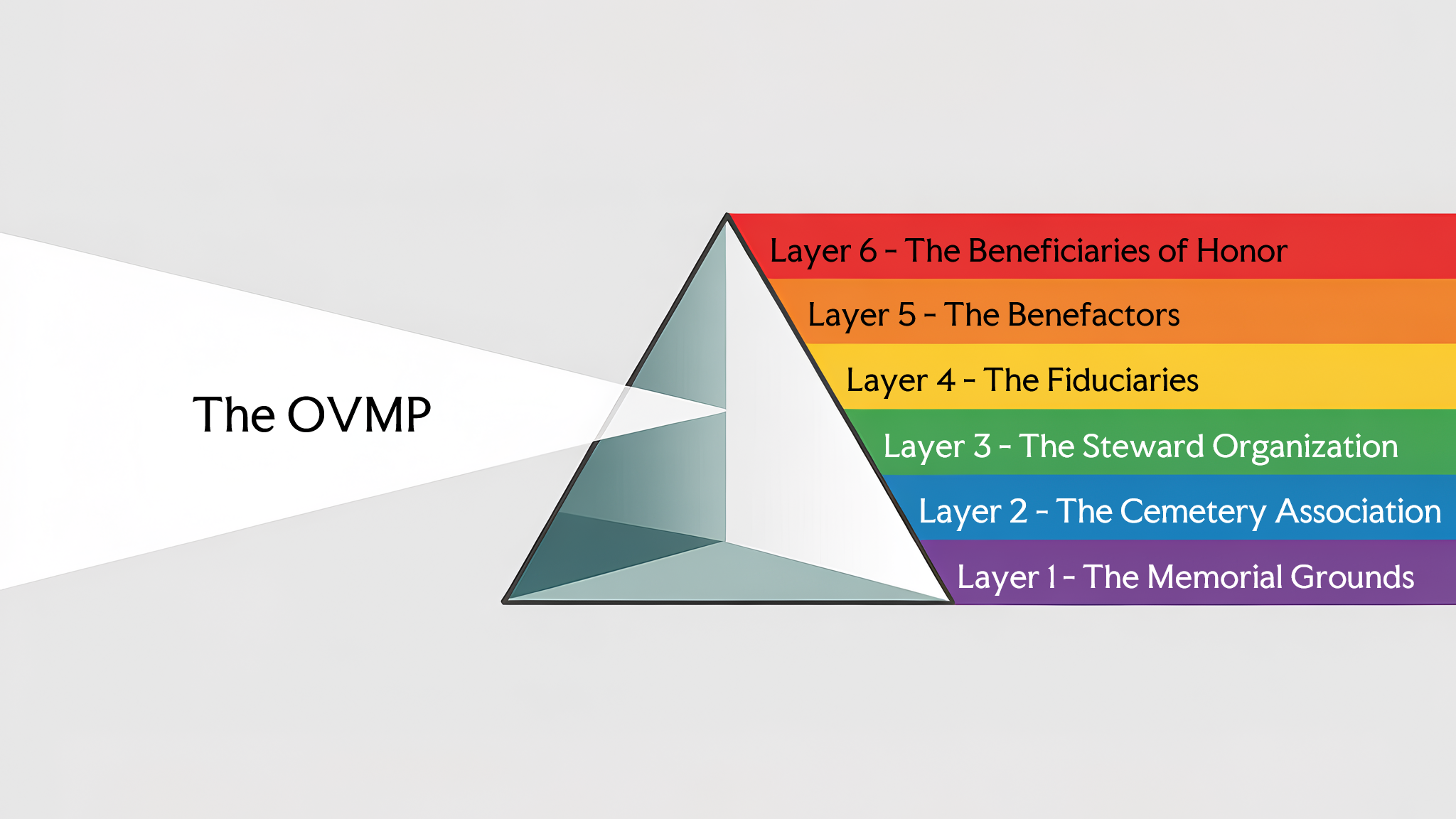
The Six-layer Model of Ohio Veterans Memorial Park
In this layered structure
Authority flows downward legally
Honor and purpose rise upward morally
Stewardship sits in between, facing upward in service.
This structure reflects how fiduciary law, cemetery law, nonprofit law, tax law, and property law actually work. In upcoming sections, each layer will be explored individually, drawing directly from the park’s documented history and governing framework.
Layer 1 — The Memorial Grounds
The Memorial Grounds are the dedicated cemetery land and permanent memorial structures that make Ohio Veterans Memorial Park physically real. In this layer, one foundational point should be unmistakable: Once land is dedicated for cemetery purposes, it enters a distinct legal category governed by Ohio Revised Code Chapter 1721 and long-standing principles of cemetery law. At that moment, the land ceases to be merely real estate capable of ordinary private use or development and becomes a dedicated environment with heightened legal and moral obligations where every use of the land must be consistent with its cemetery purposes of burial, remembrance, dignity, permanence, and protection of the dead and those they represent. Not only do the statutes found in Ohio Revised Code Chapter 1721 dictate the foregoing conclusions, but for cemetery property owned by not-for-profit associations or corporations such as the Clinton Cemetery Association, Section 501(c)(13) of the Internal Revenue Code specifies that in order for the cemetery to maintain its tax exempt status, the cemetery grounds must be used only for the burial of human remains and functions “necessarily incident thereto”.
The integration of OVMP into Clinton Cemetery was not incidental. Within cemetery property, the memorial cannot be treated as a campus, venue, or autonomous space. It is not an operating place that decides things for itself. It exists in continuity with and within Clinton Cemetery and must be protected, preserved, and regulated, accordingly, so that remembrance remains permanent rather than negotiable. Private agreements do not override cemetery dedication. They operate within it. The 2007 Agreement functions as a license layered on top of already-dedicated cemetery property, where:
no agreement can convert cemetery land into autonomous operating space,
no organization can acquire inherent control over cemetery land by contract for non-cemetery purposes,
and no amount of responsibility assumed by a steward alters the land’s legal status.
Going further, fixtures derive their legal character from the land to which they are attached. Under common-law property doctrine, an item becomes a fixture when:
it is physically annexed to land,
it is adapted to the use of the land, and
the objective intent indicates permanence.
Once installed, these are not personal property in any meaningful legal sense. They are part of the real estate. Permanent memorial structures such as walls, monuments, aircraft displays, and walkways, are not decorations. In law, they are fixtures attached to cemetery land, inheriting cemetery governance constraints regardless of who funded, built, or maintains them.
Ordinary fixture doctrine is heightened in a cemetery context. Ohio Revised Code Chapter 1721 explicitly authorizes cemetery associations to:
erect monuments,
regulate monuments,
protect monuments,
and take charge of monuments erected in honor of soldiers.
This does two things legally:
It codifies fixture control in the cemetery association, and
It removes discretion from third parties.
Even if a contract attempted to assign physical control of a monument to a non-cemetery entity, that assignment would be beyond one’s legal power or authority to the extent it conflicted with statutory cemetery authority and, for cemetery organizations such as Clinton Cemetery Association, the Internal Revenue Code.
Layer 1 therefore is not about objects. It is about statutory dominion over physical things. Thus: Layer 1 is not vague if properly stated. It is:
The layer at which dedicated land and the physical structures attached to it become legally regulated, subject to cemetery authority, tort liability, and statutory control, regardless of who funded or proposed them.
Layer 2 — The Cemetery Association
Ohio law doesn’t treat a cemetery like ordinary real estate where control easily transfers from owner to owner every time the property is conveyed. Instead, it assigns unavoidable governance power to cemetery associations to ensure continuity, accountability, and protection that outlasts individual people and organizations. As a quasi‑public steward, a cemetery association owes duties to lot owners, families, and the public interest embedded in cemetery law, and its statutory authority to protect the land, adopt and enforce rules, regulate monuments and structures, control access, conduct, and use of grounds, ensure safety, and preserve dignity.
Ohio statutes expressly give cemetery associations authority to enclose, improve, and adorn the grounds, erect buildings for its use, prescribe rules for lots and monuments, and prohibit uses or improvements of lots. They even expressly authorize cemetery associations to act as soldiers’ monumental associations and take charge of the management of cemetery grounds, or monuments especially erected in honor of soldiers or seamen. Ohio law goes even further by creating a rule-protection-enforcement regime wherein it is unlawful to violate bylaws, rules, or regulations adopted by cemeteries with reference to protection, good order, and preservation of the cemetery and its structures and adornments.
Layer 2 of the six-layer model makes the legal picture internally consistent. Statutes make the Cemetery Association the governing rule-maker and protector of cemetery grounds and structures. The Agreement has assigned duties (maintenance/insurance/etc.) to a steward, but those duties operate within the Cemetery Association’s governing framework and cannot and do not convert any portion of cemetery land into an autonomous operating domain. Importantly, this reality is not adversarial to the memorial but allows it to exist as something permanent rather than temporary, vulnerable, or subject to drift.
Layer 3 — The Steward Organization
Significant potential for confusion surrounding authority, stewardship, and control arises from the simple fact that in ordinary conversation, “Ohio Veterans Memorial Park” is often used to mean both the memorial grounds themselves and the nonprofit organization associated with them. This is not unusual in nonprofit practice, but in a regulated environment like a cemetery, it has outsized consequences. Legally, the memorial and the organization are not one in the same. They occupy different layers, are governed by different bodies of law, and carry different kinds of authority and obligation.
While the Memorial Grounds define Layer 1 in this model, Layer 3 addresses the legal nature of the OVMP organization, itself. Placed inside a cemetery setting governed by Ohio law and federal tax law, the OVMP organization exists as a steward by permission, not as an authority by right. Its powers are derivative, contingent, bounded, not inherent and, most importantly, consistent with Clinton Cemetery Association’s cemetery purpose.
The 2007 Agreement grants the OVMP organization permission that, in legal terms, most closely resembles a limited, conditional license to erect and steward a memorial, subject to and in compliance at all times with cemetery law, cemetery rules, and the Agreement, where compliance with all of the same will result in compliance with IRC 501(c)(13). In contract terms, this is a subordinate estate of permission and is not a transfer of control. The OVMP organization’s rights rise and fall with compliance, and if the Agreement conflicts with state law, state law prevails.
In property law, a licensee does not acquire possessory rights or governing authority merely because it acts on land, invests resources, or bears costs and liabilities; therefore, the assignment of significant responsibilities under the 2007 Agreement does not transform the OVMP organization into an operator. In contracts and property law, the word “responsibility” means bearing the burden or risk for something rather than being in charge of it. Responsibility never implies authority by default. Authority must be affirmatively granted. The Steward Organization’s legitimacy flows from faithful service, not from control. Once this is understood, disputes framed around “Who is in charge?” tend to dissolve, because the organization was never designed to be “in charge” in the first place.
One of the most important doctrinal insights of the Six-layer Model is that the OVMP organization does not define a permanent or necessary legal layer in the abstract. Layer 3, the Steward Organization, describes a role that exists because the OVMP organization is a legally recognized nonprofit entrusted, by permission and within law, to steward a memorial on Clinton Cemetery land. It bears real responsibilities and obligations, but it possesses no inherent authority to govern the land, redefine its use, safety standards, or adornment, or operate independently of cemetery governance and statutory constraint. The organization’s continued assignment to this layer is contingent on continued compliance, suitability, and trust, not the other way around.
In Layer 3, the OVMP organization exists to serve upward, not command downward. It sits between the authority that anchors the memorial and the people and purpose the memorial exists to honor.
Layer 4 — The Fiduciaries
One of the most common and most dangerous errors in nonprofit governance is mission exceptionalism: the belief that devotion to a noble purpose justifies bending rules or reinterpreting constraints. In the early days of the OVMP, people persisted when others gave up, they pushed past obstacles that caused others to yield, and they treated the mission as too important to fail. But the mindset that can be essential to bringing a memorial into being is not always acceptable once stewardship carries legal discretion and responsibility. While the law does not reject mission exceptionalism categorically, it rejects mission exceptionalism in moments of discretion and control.
Layer 4 exists to answer a question that corporate and nonprofit law treats as foundational: Who is legally responsible for judgment when devotion meets discretion? The answer, in law, is never “the organization” alone. It is the people who control it, the fiduciaries. While the Steward Organization exists to act, the Fiduciaries exist to judge whether action is lawful, faithful, and appropriate. It is the trustees, directors, and officers upon whom the law imposes the fiduciary obligations of:
Loyalty (acting for the organization’s purpose, not personal interest)
Obedience (faithfulness to mission, law, and governing instruments)
Care (informed, attentive decision-making)
These duties are personal and non-transferable. They do not dissolve into “board consensus,” nor are they erased by good intentions, passion for the mission, or volunteer status. This is why fiduciary law insists on identifying who held the duty at the moment judgment was exercised. Individuals come and go, but while they serve, their obligations are real, personal, and enforceable.
Whenever the Fiduciaries are faced with choices about design interpretation, safety tradeoffs, donor intent, compliance with cemetery rules, or alignment with governing agreements, they are not merely “advancing the mission.” They are exercising legal discretion that must be justified under fiduciary standards. There is a reason fiduciary framing is so powerful: No one argues with fiduciary duty unless they intend to escape it.
The Fiduciaries exist as a distinct layer because fiduciary duty attaches personally to individuals who exercise judgment on behalf of the steward organization. Those duties cannot be absorbed by the organization, delegated away, or justified by mission alone, and they require decisions to be made within legal constraint, not beyond it. Once this is understood, appeals to organizational identity, passion, or responsibility lose their force. What remains is the only question fiduciary law ever really asks: Did you act faithfully, lawfully, and in service of those to whom the duty was owed?
Layer 5 — The Benefactors
The 2007 Agreement requires that no construction is to begin on any phase of the memorial until all monies related to the construction of that phase have been raised, received, and collected. Such a seemingly straightforward stipulation illustrates a profound truth: The memorial could never have moved forward without benefactors first acting in reliance, committing money, labor, and trust so that construction in each new phase could lawfully begin.
In practical terms, the Benefactors defining Layer 5 are the enablers of the memorial’s purpose. In fiduciary terms, they are reliance-holders, meaning that when they gave money, labor, materials, time, or trust, they relied on the stated memorial purpose, the models and materials they were shown, the cemetery setting, the governing agreement, and the expectation of lawful, faithful stewardship. That reliance is what triggers fiduciary obligation from Layer 4. The Benefactors do not govern or control, but they are people to whom service is owed.
A benefactor is defined not by the size of a gift, the form of contribution, or proximity to decision-making, but by what their contribution enabled:
From the families and friends who purchased engraved memorial bricks at $50 each to the older woman who carried bricks, one at a time, to the brick layer so the walkways honoring Ohio’s veterans could be laid by hand;
Or from a widow whose life-insurance donation made in honor of her husband became the catalyzing first step toward the engraving of the names of Ohio’s 1,822 Korean War fallen onto the east side of the Ohio Vietnam Wall to the volunteers who quietly wash the Wall, clean monuments, mow grass, and pull weeds so remembrance looks intentional every single day.
The same principles apply to supporters whose contribution is labor as to those whose contribution is financial. One is no less important morally or more authoritative legally than the other. This uniform treatment is deliberate. It prevents governance from fracturing into competing claims of effort, seniority, or sacrifice. At the same time, the law does not treat benefactor contributions as indifferent or disposable. Fiduciaries remain legally obligated to respect the purposes and representations that induced reliance. People who donated did not do so to empower an organization. They did so with intention to enable a specific memorial.
In law, permanence is achieved in different ways. While physical structures become permanent through property and cemetery law, financial resources become permanent through charitable trust and fiduciary law. In both cases, what is given for the memorial is no longer subject to individual discretion or organizational preference. It is bound to the memorial’s purpose. Funds raised for the memorial are permanently bound, as a matter of fiduciary obligation, to the memorial’s use and purpose, and stewardship of those funds exists only so long as it serves that end.
The Six-layer Model places benefactors above fiduciaries for a reason that is doctrinal, not sentimental. Fiduciaries owe duties to someone. Benefactors are part of that collective “someone.”
Together,
the Benefactors of Layer 5 make the charitable purpose possible,
the Fiduciaries of Layer 4 are bound to serve that purpose faithfully,
and the Steward Organization of Layer 3 exists to carry out that service.
Layer 6 — The Beneficiaries of Honor
In common usage, a beneficiary is usually thought of as someone who gains financially or someone in line to receive something material, but in Layer 6, beneficiaries are not recipients of advantage but of purpose. They are recipients of honor in the form of remembrance, dignity, recognition, and meaning. However, this designation doesn’t just stop at what they receive but how the structure is oriented toward them. This layer sits at the top for a reason. Beneficiaries are not the foundation of the structure. They are its meaning. The Beneficiaries of Honor are Ohio’s fallen being memorialized, veterans, their families, and the public purpose the memorial exists to serve.
Most evidently, the Ohio Vietnam Veterans Memorial Wall, a defining feature of Layer 1, is a permanent fixture installed on dedicated cemetery land. It is immovable, name-specific, and designed for perpetual presence, but the west face of the wall exists for the benefit of Ohio’s 3,095 Vietnam War fallen, specifically, named beneficiaries of honor whose deaths gave rise to a legally protected interest in remembrance, enforced through cemetery, charitable, and fiduciary law.
However, cemetery law recognizes that remembrance serves not only the dead but those who must live with the loss, and two other prominent Layer 1 fixtures, the Gold Star Mother and Gold Star Father monuments, exist for the benefit of the parents and families of the fallen. The law also recognizes that different forms of sacrifice generate different protected interests, with the POW/MIA Pond and Wall and the Purple Heart Monument existing for distinct classes of beneficiaries in Layer 6 whose burdens are ongoing.
Finally, the plaza along the main walkway, where each branch of the U.S. military is represented by a permanent flagpole and monument, illustrates that some memorial features exist not for individual names or families, but for veterans as a class, honoring service itself as a legally-protected interest fixed in place through permanent fixtures on cemetery land.
Cemeteries treat veterans and families as those to whom honor is owed, not those who must request it, and fiduciary law requires faithfulness to the specific form through which that honor was publicly defined and consistently presented on their behalf. The monuments fix that form into the landscape where it cannot drift, dilute, or be reinterpreted over time.
For the OVMP, Layer 1 exists because Layer 6 exists. All other layers exist only to make that relationship lawful, durable, and faithful. Once this is understood, questions of autonomy, entitlement, and governance resolve themselves.
The Final Answer
So, who does Ohio Veterans Memorial Park belong to?
In setting out to answer that question, it was important to align the public story of Ohio Veterans Memorial Park with its legal reality, in a way that is accurate, respectful, and complete. In doing so, it became evident that the OVMP expands into six layers, each governed by a different body of law, enforced by different doctrines, and protected for different reasons. Once that had been accomplished the question became: Within each layer, what belongs to whom, and in what sense?
Thus, there is not one final answer but six.
Layer 1 — The Memorial Grounds
The land and structures belong to the cemetery as regulated real estate, not as a discretionary asset. They have been withdrawn from ordinary private control by cemetery dedication.
Layer 2 — The Cemetery Association
Authority belongs to the Association by statute and tax law, not by agreement.
Layer 3 — The Steward Organization
The role of steward belongs to this organization as long as permission, compliance, and trust remain intact. It is a license to act, not the right to decide.
Layer 4 — The Fiduciaries
Obligation belongs to the individual directors and officers of the Layer 3 steward organization, not to the title they sit under. Fiduciary duty belongs to people, and it is owed to those whose trust, reliance, and protected interests the organization exists to serve.
Layer 5 — The Benefactors
The memorial’s means belong to the purpose for which people gave them. The Benefactors have the right to have their reliance honored and the right to not have purpose betrayed.
Layer 6 — The Beneficiaries of Honor
The memorial’s reason for existing at all, honor in the form of remembrance, dignity, and meaning, belongs to the Beneficiaries of Honor - Ohio’s fallen, veterans, their families, and the public purpose of remembrance.
The Six-layer Model addresses the introductory question around a familiar word, belong, by showing that the law has been answering that question all along, just not in the way people assume. The model doesn’t try to argue for belonging. It shows where the belonging is located.